Lower Eyelid Fat Removal vs. Fat Repositioning: The Differences That Emerge Over Time
Views : 171
Introduction
Have you ever heard someone say that they were happy with their results right after surgery, but when they looked again a few months later, something felt different?
Lower eyelid fat surgery comes in two forms: removing the fat, or relocating it. The difference between these two approaches tends to show up more clearly not immediately after surgery, but in how the under-eye area looks months and years later.
Today, let us go over why fat removal and fat repositioning take different paths over time, and what to look at when judging that difference.
Why Things Change Over Time
The fat-removal approach reduces the volume of the area itself. Right after surgery, swelling often makes the area look natural, but as the swelling subsides, the volume that actually remains becomes visible.
A flower bed makes this easy to understand. Imagine one side of the bed piled high with soil while the other side is sunken. If you scoop up the soil from the raised side and simply throw it away, that spot becomes lower, but the sunken part is left exactly as it was. If instead you move that soil over and fill in the sunken side, the entire bed is leveled evenly.
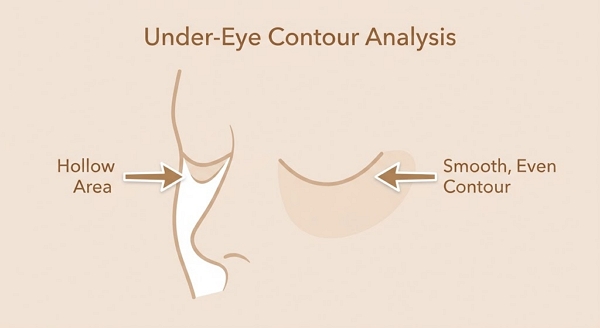
The lower eyelids work the same way. Removing fat reduces the bulge, but the hollow that was already there is left unfilled. As natural volume loss adds up over time, a hollowness that was not noticeable at first can become increasingly prominent.
The fat-repositioning approach, by contrast, rearranges the fat's position while preserving the overall volume, so the balance tends to hold up better over time.
How Tendencies Differ Over Time
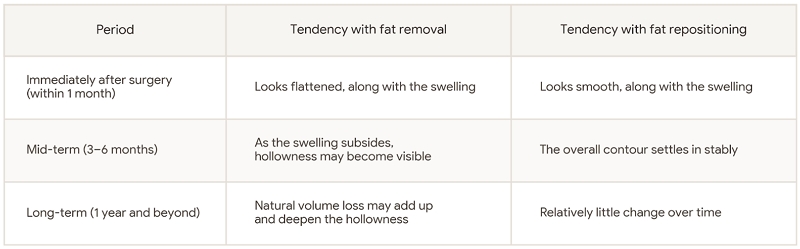
This table shows general tendencies; results vary from person to person depending on individual fat volume and skin elasticity.
Self-Check List
There is a bulge under the eyes, and a groove-like hollow beneath it is visible at the same time.
You have thought that things would improve if only the bulge could be removed.
You have been told that overall facial volume decreases with age.
An area where fat was removed in the past now looks more sunken.
Your under-eye condition tends to fluctuate noticeably with the season or your physical condition.
If two or more of these apply to you, it is worth considering not just the current bulge, but also how the area will look months from now.
Five Things to Confirm at Your Consultation
Which approach is being considered for your current condition: fat removal or fat repositioning
Whether the provider explains in advance how the results may change over time
What additional methods are used during repositioning to keep the fat from being pushed back out
How it is determined whether volume supplementation is needed when the tear trough is deep
Whether there is a follow-up process to check progress several months and one year after surgery
Why Planning Should Account for Time
The results of lower eyelid fat surgery should be judged not by how they look immediately after surgery, but by how they look months or a year later. Focusing only on reducing the current bulge can, over time, make the hollowness stand out all the more.
At TheUK Plastic Surgery, fat repositioning is performed together with double fixation and septal reinforcement, an approach designed to lower the possibility of the fat pushing forward again.
Dr. Jang Uk takes as his standard the practice of planning surgery with not only the bulge visible today, but also the changes that time will bring.
Rather than deciding based only on how you look today, we encourage you to picture how you will look a few months from now as well when choosing your method.
theuk plastic surgery